
Achieving inflation target of 4 per cent, recovery after remonetisation and hardening profile of oil prices are some of the risks which the RBI is watching closely, says Gaurav Kapur.

RBI deputy governor N S Vishwanathan has said the new framework was in line with the Insolvency and Bankruptcy Code guidelines.

The corporate sector does not care from where the money is coming.

Exposure to debt funds and gold is essential even if current returns from these asset classes are low, suggests Sanjay Kumar Singh.

Soon after RBI announcing a much- awaited rate cut, Chief Economic Advisor Arvind Subramanian on Wednesday said that the global rating agencies should look at upgrading their stance on India's credit outlook. "Now we have a 50 basis points rate cut (in two tranches within two months) and I think that is good for the economy and all rate cuts benefits... If the outlook is looking good, the rating agencies should draw their lessons from that om improving the outlook," Subramanian told reporters. After presentation of Union Budget 2015-16 last week, global and domestic agencies had ruled out any immediate upgrade in India's sovereign ratings and had red-flagged the country's delayed fiscal consolidation roadmap and had also warned against any slippages from the "ambitious" disinvestment plan proposed in Budget. Subramanian said that the rate cut is consistent with the government's views in the last week's Economic Survey and thereafter in the Union Budget for the outlook on inflation and for the outlook on overall economy. "It (rate cut) shows that RBI and government are on the same page in terms of how we view the economy. It also means that Budget can be seen as conducive to non-inflationary growth," he added. On monetary policy framework agreement, Subramanian said that both Finance Ministry and RBI have shared concern about inflation. Recently, the Finance Ministry and the Reserve Bank agreed to 'inflation rate targeting' under which the apex bank will aim to lower retail inflation to below 6 per cent by January 2016.

India has not been able to compete with countries such as Bangladesh and Vietnam.

Between Friday's and Monday's close: Yields on 10-year bonds up 6 basis points, rupee slides 13 paise against dollar, Sensex ends flat

She said 30 basis points (0.30 per cent) rate cut has already happened.

The Reserve Bank of India (RBI) is likely to take a "more dovish" stance in its upcoming monetary policy review on December 2 and may go in for a cut repo rate in February, according to a British brokerage house report.

Most economists feel the RBI has room for a 25-basis point cut, having met inflation targets comfortably

RBI projects GDP growth in FY16 at 7.8 per cent, 30 bps higher than FY15. However, this comes with a downward bias.

The wholesale price-based inflation accelerated to a record high of 12.94 per cent in May, on rising prices of crude oil and manufactured goods. Low base effect also contributed to the spike in WPI inflation in May 2021. In May 2020, WPI inflation was at (-) 3.37 per cent. This is the fifth straight month of uptick seen in the wholesale price index (WPI)-based inflation. In April, 2021, WPI inflation hit double digit at 10.49 per cent. "The annual rate of inflation, based on monthly WPI, was 12.94 per cent for the month of May, 2021 (over May, 2020) as compared to (-) 3.37 per cent in May 2020.

India's GDP for the three-month period ended September 30 grew 7.4%.

There is a narrow chance that the central bank may cut rates in the future, according to a poll of 15 economists and treasurers.

The RBI was not party to the decision to demonetize 500 and 1,000-rupee notes, which was taken at the highest level of India's political leadership.
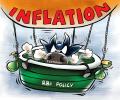
'While intensification of fuel prices and broad-based domestic cost pass-through pressures is a downside risk, core inflation is expected to strengthen further as demand recovers to pre-Covid levels,' the ministry said on Friday.

YES Bank raises base rate; HDFC Bank, Axis hike deposit rates.

The RBI announced its monetary policy on Tuesday.
RBI retained the GDP growth for the financial year 2018-19 at 7.4 per cent.

Analysts at Bank of America Merill Lynch said that fears of inflation getting "generalised" are overdone, as only two sub-categories of fuel and light and housing (accounting for 22 per cent of the basket) have seen a price-rise above the headline 5.2 per cent.

After Urjit Patel's appointment as RBI governor-designate, the bond market witnessed a sell-off, as it became evident that there won't be any significant change in stance

RBI is expected to discuss about the impact of GST in its monetary policy.

The government hopes the latest action will lead to banks also lowering the cost of borrowing for corporate and individual borrowers.

HCL Tech was the top loser in the Sensex pack, skidding over 4 per cent, followed by Tech Mahindra Dr Reddy's, Wipro, TCS, Titan and Infosys. NSE Nifty plunged 167.80 points to 17,110.15.

Brokerage firm Nomura said inflation levels in India are close to post global financial crisis lows, and also retained its positive stance on Sensex.

After two surprising, successive rate cuts in January and February 2015, RBI governor Raghuram Rajan decided not to reduce them further in his first policy announcement in the new financial year. Is he playing spoilsport for consumers of homes and cars?

India's voting pattern in the United Nations with regard to the Israel-Palestine conflict is lately marked by a calibrated distancing from Israel, observes Ambassador M K Bhadrakumar.

The repo rate, at which the central bank lends to the system, will come down to 5.75 per cent after the cut.

RBI wants periodic revision of the pensions for its retired employees.

First, there has been a significant softening in commodity prices - most notably oil.
For July-September, it pegged CPI-based retail inflation at 4.2 per cent which it saw firming up to 4.8 per cent in the second half of the current fiscal.

The Sensex finished above the psychologically key 60,000-mark while the Nifty surged past the 18,000-level on Monday on across-the-board buying amid a mixed trend overseas. A depreciating rupee and concerns over the US Federal Reserve hiking rates later this week failed to quell investors' appetite for stocks, traders said. The 30-share BSE Sensex rallied 786.74 points or 1.31 per cent to settle at 60,746.59.

'The rate cut will reduce the stress on customers and help the bank reduce its provisioning bill.'

So long as there are concerns about world trade, growth and oil prices, the domestic market will remain volatile.
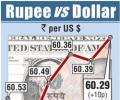
Forex dealers said besides increased selling of the American currency by exporters and banks, a higher opening in the domestic equity market and the dollar's weakness against other currencies overseas supported the rupee.

The bond market expects at least 25 basis points cut in the June 6 policy.

The wholesale price-based inflation rose for the second consecutive month in February to 4.17 per cent, as food, fuel and power prices spiked. The WPI inflation was 2.03 per cent in January and 2.26 per cent in February last year. After witnessing months of softening of prices, the food articles in February saw 1.36 per cent inflation. In January it was (-) 2.80 per cent.

High inflation print is the price that the Reserve Bank of India (RBI) will have to pay to nurse a fragile growth back, say economists. Wholesale Price Index-based inflation rose to a record high of 12.94 per cent in May, aided by low base effect, but also because of higher fuel and commodity prices. Retail inflation, too, surprised by rising to 6.30 per cent, while the core inflation, which is the non-food and non-fuel component, rose to an 83-month high of 6.55 per cent. These numbers are much above RBI's upper limit of 6 per cent inflation target, but there is very little that the RBI can do at this moment.

Moody's expect RBI to hold policy 'repo' rate steady to have a neutral stance in this growth

Monetary policy stance to depend on inflation data
